
It usually starts with something very small.
A late meeting.
One unread message.
Dinner getting cold… again.
You joke about it at first.
“Corporate life hai yaar.”
“Bas thoda sa pressure chal raha hai.”
But slowly, that joke turns into silence.
And silence turns into assumptions.
And assumptions quietly become fear.
I often tell my clients—marriages don’t break loudly.
They break softly… between Google Calendar alerts and unread WhatsApp messages.
As a Govt.Recognized Counsellor & Mind Healer, I’ve seen how long working hours don’t just exhaust the body—they slowly reduce intimacy in marriage, emotionally, mentally, and sometimes physically, without either partner fully realizing what’s happening.
also read: how mismatched work schedules createemotional distance?

Most couples don’t come saying,
“We have intimacy issues.”
They say things like:
One partner feels neglected.
The other feels guilty and overwhelmed.
And both feel misunderstood.
In Hinglish, they often say:
“Kaam khatam hota hi nahi hai… aur jab hota hai, energy khatam ho chuki hoti hai.”
This emotional distance doesn’t come from lack of love.
It comes from chronic exhaustion, unprocessed stress, and emotional unavailability created by overworking.
also read: why being together all day stillfeels lonely for couples?

Here are some common signs I observe clinically in couples affected by long working hours:
These are not “relationship failures.”
These are stress responses.
also read: when work stress replaces emotionalconnection at home?
From a clinical lens, prolonged work stress contributes to conditions recognized in DSM-5 and ICD-11, such as:
Adjustment Disorder (DSM-5)
Chronic work stress leads to emotional or behavioral symptoms—withdrawal, low mood, irritability—that directly affect marital intimacy.
When emotional energy is drained at work, nothing is left for the marriage.
Relationship Distress With Spouse or Intimate Partner (DSM-5 Z Codes)
This category acknowledges that relational suffering can exist even without a mental disorder, and still deeply affect emotional and psychological health.
Your marriage is reacting normally to abnormal levels of stress.
also read: how dual income couples slowly drift apart withoutnoticing?
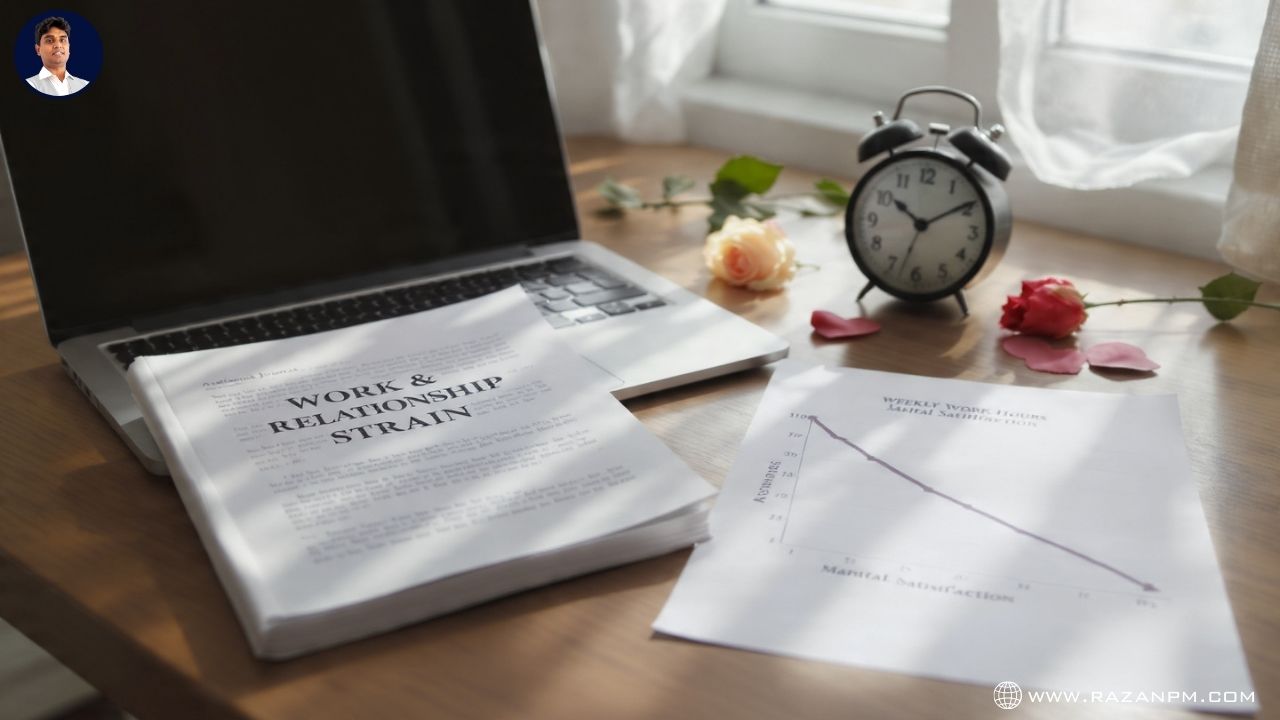
Research consistently supports this connection:
So if you’re feeling disconnected, you’re not imagining it.
Your nervous system is overwhelmed.
also read: why apologizing first does not mean you are wrong?
Let me share a real story (identity changed).
A couple in their mid-30s came to me.
Both successful.
Both tired.
The wife said, with tears:
“He is a good man… but I feel invisible.”
The husband said quietly:
“I work so hard for us… and still feel like I’m failing.”
What broke my heart wasn’t anger—it was loneliness sitting right next to love.
We didn’t start with communication techniques.
We started with healing exhaustion.
Once their nervous systems calmed down, intimacy didn’t need to be forced.
It returned naturally.
Because intimacy isn’t about time—it’s about emotional presence.
also read: how constant blame ruins mental health inmarriage?

Here’s a simple but powerful exercise I give many couples:
The 10-Minute No-Problem Zone
Every day, just 10 minutes.
Rules:
Only this question:
“How did today feel for you?”
Listen.
Not to reply.
But to understand.
This small ritual rebuilds emotional safety, which is the foundation of intimacy.
Try it for 7 days.
Notice the shift.
also read: why men depression often begins with constantfatigue?
Here’s the truth most blogs won’t tell you:
If long working hours have already trained your brain into survival mode,
one tip won’t undo years of emotional suppression.
Deep intimacy restoration requires:
This is not about blaming work.
It’s about reclaiming your emotional space.
also read: the fear of being replaceable in the ai job era
If this blog felt familiar, please know this—
You are not weak.
Your marriage is not broken.
You are just tired… emotionally.
And you don’t have to figure this out alone.
As a Govt.Recognized Counsellor & Mind Healer, I help couples gently reconnect without blame, pressure, or shame.
If your heart says “this is us,”
you’re welcome to book a 1:1 consultation and take the first safe step toward healing.
Sometimes, all a marriage needs is guided emotional rest.
👉 Begin Your Journey with a 1 on 1 Consultation
👉 Begin Your Journey with a 1 on 1 Consultation

Long working hours drain emotional and mental energy, making partners emotionally unavailable. Over time, this reduces emotional connection, physical closeness, and meaningful communication in marriage.
also read: why gen z feels pressure to recordevery moment
Yes. Chronic work stress keeps the nervous system in survival mode, which lowers emotional responsiveness and bonding hormones, leading to emotional distance even in loving marriages.
also read: why every argument feels like apersonal attack
Not at all. Reduced intimacy often reflects exhaustion, burnout, or unresolved stress rather than lack of love. With awareness and emotional healing, intimacy can be restored.
also read: how emotional isolation triggersschizophrenia like symptoms?
When conversations become task-focused and emotional sharing disappears, partners feel unseen and unheard. Physical presence without emotional presence creates loneliness in marriage.
also read: why many wives experience silentdepression in marriage?
Burnout causes emotional numbness, irritability, and reduced desire for closeness. The brain prioritizes rest and survival over connection, affecting both emotional and physical intimacy.
also read: how gen z confuses trauma bondingwith real love?
Yes. Conditions like adjustment disorder, chronic stress, and occupational burnout recognized in DSM-5 and ICD-11 often include relationship distress and reduced emotional bonding.
also read: how over loyalty is quietly breakinggen z?
In many cases, yes. Emotional regulation, better communication, and intentional connection practices can rebuild intimacy even if work demands remain high.
also read: why gen z checks their phone whennothing is there?
A short daily emotional check-in without phones, advice, or problem-solving helps restore emotional safety and connection between partners.
also read: why loneliness hurts more when loveslowly fades?
If emotional distance, loneliness, or communication problems persist despite efforts, seeking guidance from a clinical psychologist and Govt.Recognized Counsellor can help address deeper emotional patterns safely.
also read: how constant rejection from apartner can trigger anxiety?
Therapy helps calm the nervous system, improve emotional awareness, rebuild trust, and teach healthy ways to reconnect without blame or pressure.
also read: why women stay silent whenemotionally hurt?
Emotional intimacy forms the foundation of physical intimacy. When emotional safety and connection improve, physical closeness often follows naturally.
also read: how friendship breakups impactmental health deeply?
Yes. Small changes in emotional response, understanding, and communication by one partner can slowly shift the relationship dynamic and invite reconnection.
also read: how friends success triggersjealousy?