
Have you ever noticed how a tiny thing becomes a full Bollywood level emotional drama in your mind?
Your partner says, “Hmm.”
Bas. Sirf ek “hmm.”
And suddenly your brain starts a Netflix series:
“He sounds cold.”
“Maybe he is upset.”
“Did I do something wrong?”
“Is he losing interest?”
“Is this how marriages fall apart?”
Within five minutes, a normal evening turns into silent tension, negative thoughts, fear, and sometimes even emotional trauma.
Irony dekhiye… you both are talking more than ever. Long discussions. Late night conversations. Relationship podcasts. Advice from friends.
Phir bhi… the emotional distance in marriage is growing.
As a Govt.Recognized Counsellor & Mind Healer, I hear this line almost every week:
“We talk a lot. But we still feel far from each other.”
So let’s explore the uncomfortable truth.
also read: who decides what married women canwant?

Most couples believe that communication problems in relationships can be solved by simply talking more.
But emotional distance is not a volume issue.
It’s a connection issue.
You can talk for two hours and still feel alone.
You can discuss bills, kids, schedules, relatives… and still not feel emotionally safe.
Talking more does not automatically mean:
Sometimes, talking more actually increases distance.
Why?
Because when the core emotional wounds are untouched, every conversation becomes defensive.
also read: when motherhood is treated as anobligation?

Let me describe what many of my clients confess in therapy.
“I feel lonely in my marriage.”
“We sit together but I feel alone.”
“I explain my feelings but he does not get it.”
“She says I don’t understand her, no matter what I say.”
On the outside, they look like a “normal couple.”
Inside, there is silent emotional disconnection.
Many people feel:
And slowly, the mind creates a protective shield.
When this continues, couples start searching:
But they focus on “how much we talk” instead of “how safe we feel.”
also read: how comparing marriages destroywomens inner peace?

Here are some common signs I observe clinically:
1. Conversations Feel Mechanical
You talk about tasks, not feelings.
2. Defensiveness Increases
Every small feedback sounds like criticism.
3. Avoidance of Deep Topics
You avoid sensitive subjects to prevent fights.
4. Emotional Withdrawal
One partner becomes silent or emotionally unavailable.
5. Physical Intimacy Reduces
Emotional distance and physical distance often go together.
6. Chronic Negative Thoughts
You assume the worst about each other.
Over time, this can contribute to anxiety, low mood, and relationship dissatisfaction.
also read: why many women feel lonely aftermarriage?
Now let’s understand this scientifically.
Emotional distance itself is not a separate disorder in the DSM 5 (Diagnostic and Statistical Manual of Mental Disorders) or ICD 11 (International Classification of Diseases).
However, it is often linked to:
In DSM 5, there is a condition called Relationship Distress with Spouse or Intimate Partner, which acknowledges that relational dysfunction can significantly affect mental health.
ICD 11 also recognizes relational problems as psychosocial stressors.
When emotional disconnection persists:
So even when you are talking, your nervous system is not feeling safe.
And without safety, emotional intimacy cannot grow.
also read: why living with in laws drainsemotional health?
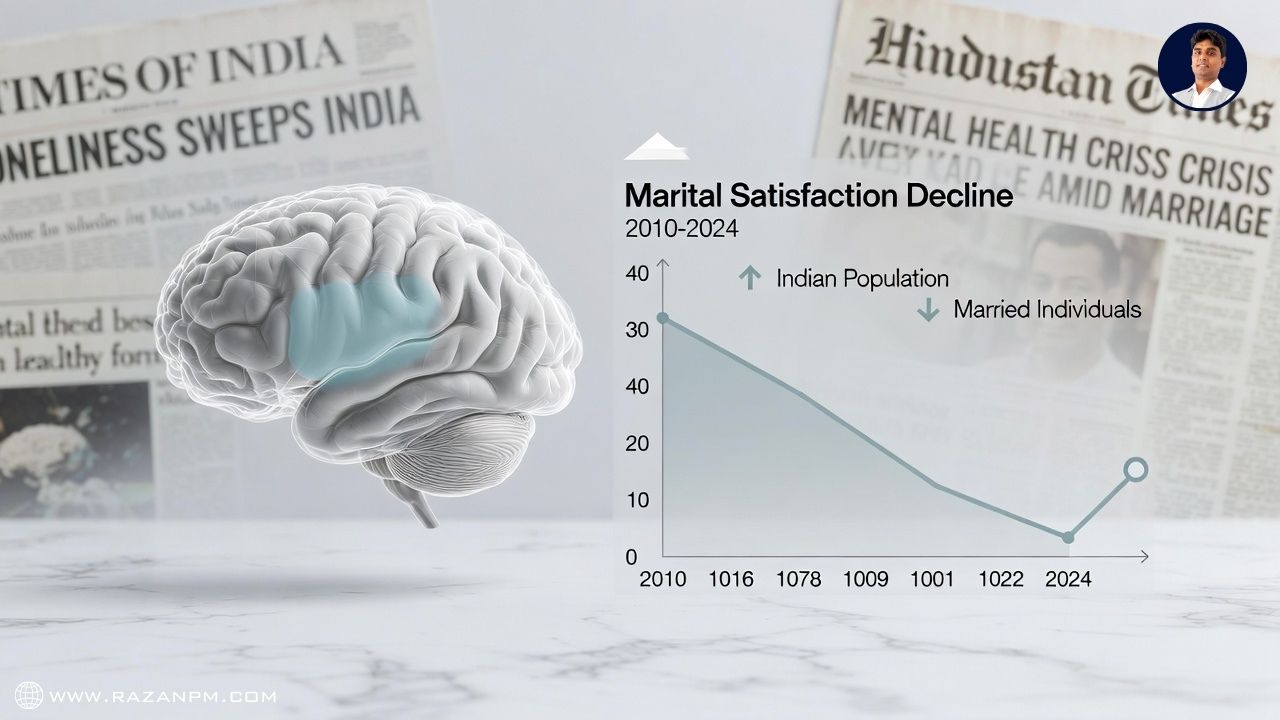
Research in couple psychology, especially from attachment theory and emotionally focused therapy, shows:
Studies in marital psychology show that it is not the number of conversations, but the quality of emotional responsiveness that matters.
It’s not “How much do you talk?”
It’s “Do you feel emotionally seen?”
also read: why women are called difficult forsetting boundaries?
Let me share a story.
A couple once came to me. Let’s call them Riya and Arjun.
They said, “We talk daily. We discuss everything. But we feel empty.”
During sessions, I noticed something.
Every time Riya expressed hurt, Arjun tried to fix it logically.
Riya: “I feel ignored.”
Arjun: “But I come home on time.”
Riya: “I feel alone.”
Arjun: “We just went out last weekend.”
On the surface, Arjun was communicating.
But emotionally, he was defending.
One day, I gently asked Arjun:
“When she says she feels alone, can you say – I did not realize you felt that way, tell me more?”
He paused. His eyes softened.
That day, for the first time, Riya cried in relief.
Not because they talked more.
But because she felt emotionally received.
That was the turning point.
I realized something powerful:
Emotional distance reduces when people feel emotionally validated, not intellectually corrected.
also read: why marriage changes a woman morethan you realize?

Here is one practical exercise you can try tonight.
It is called the 3 Step Emotional Mirror.
Step 1: Listen Without Interrupting
For 3 minutes, just listen.
Step 2: Reflect Emotion, Not Logic
Instead of solving, say:
“It sounds like you felt hurt.”
“It seems you felt ignored.”
Step 3: Validate
“I can understand why that would feel painful.”
No advice.
No correction.
No defense.
Bas sirf emotional acknowledgement.
Do this for one small topic.
You will notice a shift.
Because emotional intimacy grows in safety, not debate.
also read: the full time job married women dowithout pay
But let me be honest.
If emotional wounds are deep…
If childhood attachment trauma is involved…
If anxiety or depression is active…
Then surface level techniques are not enough.
Sometimes emotional distance is rooted in:
These patterns are wired in the nervous system.
And rewiring them requires guided therapeutic work.
A blog can create awareness.
But healing often needs safe structured support.
also read: why marriage expectations hurt womenmore than we admit?

Because:
Talking is a skill.
Emotional safety is an experience.
Talking is verbal.
Connection is nervous system based.
Talking explains.
Validation heals.
And until couples shift from “proving” to “understanding,” emotional distance continues.
also read: how financial support turns intocontrol in marriage?
If you are reading this and thinking:
“This feels like my story.”
Please know something important.
You are not broken.
Your partner is not the enemy.
Your nervous systems are protecting you.
Emotional distance is not a failure.
It is often unhealed fear wearing armor.
And armor can be gently removed in the right space.
If this feels familiar, you don’t have to figure it out alone.
You can book a supportive 1:1 consultation and begin rebuilding emotional intimacy step by step.
Healing starts with one safe conversation.
👉 Begin Your Journey with a 1 on 1 Consultation
👉 Begin Your Journey with a 1 on 1 Consultation

Emotional distance in marriage usually happens when partners stop feeling emotionally safe with each other. It can develop due to repeated misunderstandings, unresolved conflicts, childhood attachment wounds, stress, anxiety, or feeling unheard. Over time, the nervous system shifts into protection mode, creating emotional withdrawal instead of connection.
also read: why marriage changes how societysees women?
Yes. Communication problems in relationships often lead to emotional disconnection when conversations become defensive, critical, or solution focused instead of emotionally validating. Talking more does not help if partners do not feel emotionally understood.
also read: hidden responsibilities women handle withoutcredit
Feeling lonely in marriage despite talking often means your emotional needs are not being acknowledged. You may be sharing words, but not experiencing emotional validation, empathy, or vulnerability. Emotional intimacy is built through safety, not just conversation.
also read: marriage guilt every successful woman secretlyfeels?
Common signs of emotional distance include:
If these patterns continue, relationship satisfaction can decline.
also read: why marriage stress hits womens mental healthhard?
To rebuild emotional intimacy, couples need to practice emotional validation, active listening, and vulnerability. Instead of correcting or defending, try reflecting your partner’s feelings. Structured couple therapy or emotionally focused therapy can also help address deeper attachment wounds.
also read: when marriage suffers because family always comesfirst?
Yes. Emotional distance can be linked to anxiety, depression, attachment disorders, and relationship distress recognized in DSM 5 and ICD 11. Chronic emotional disconnection can increase stress levels and impact overall mental well being.
also read: 7 reasons women stay silent when emotionally hurt?
Absolutely. Couples therapy and psychological guidance help identify root causes such as fear of rejection, abandonment issues, or unresolved trauma. With professional support, emotional safety and intimacy can gradually be rebuilt.
also read: why so many people struggle with hyperindependence trauma?
Talking can make things worse when partners focus on proving their point instead of understanding emotions. If conversations trigger defensiveness, criticism, or past emotional wounds, it can increase distance instead of connection.
also read: why a wifes higher income triggers emotionaldistance in men?