
If you’ve ever watched a newly married boy-turned-husband standing between his maa and biwi during a heated argument… you’ve probably seen that expression.
That confused, terrified look as if someone pressed Ctrl + Alt + Delete on his brain.
A small cheez—like kisne remote rakha, ya daal mein namak zyada— suddenly turns into World War 3.
And in that exact moment, the husband thinks…
“Bas… ab toh mein gaya.”
Ek taraf maa ka emotional pressure, doosri taraf wife ka silent judgment, aur beech mein woh— jise lagta hai ki is ghar ki ‘peace treaty’ sirf uski responsibility hai.
And then, something strange happens.
He stops talking.
He freezes.
Smiles less.
And slowly, that heavy silence grows louder than any words he could have said.
also read: why quiet relationships often meandisconnection?

I’ve had many couples who approached me for counselling with the same complaint:
The wife says:
“He doesn’t talk. He shuts down. I feel invisible.”
The mother says:
“Woh pehle jaisa nahi raha. Ab chup rehta hai.”
And the husband…
He just stares at the floor, quietly, hoping no one asks him whom he supports.
Because if he supports his mother = “Maa ka beta.”
If he supports his wife = “Biwi ka ghulam.”
So he chooses the safest-looking option: Silence.
What they don’t realise is that this silence is not peace; it's emotional overload.
Inside, he is screaming:
“I love both of you. Why do I have to choose?”
And that’s where emotional trauma begins.
also read: why gen z couples regret moving intoo soon?

Here are common psychological signs I see in men stuck in this conflict:
1. Overthinking & Negative Thoughts
Obsessing over,
“What did I say wrong?”
“Did I hurt her?”
“Maa ko bura toh nahi laga?”
2. Emotional Withdrawal
He avoids conversations to prevent another argument.
3. Stress & Fatigue
Even small disagreements feel exhaustingly heavy.
4. Fear of Confrontation
Not because he lacks courage, but because he doesn’t want to hurt either side.
5. Guilt Loop
He feels guilty towards his wife and his mother—even when he did nothing wrong.
6. Passive Communication
Nods instead of speaking.
Says “Haan thik hai” to avoid conflict.
Pretends to be busy.
7. Silent Emotional Burnout
He smiles outside, but inside feels drained and suffocated.
This is not “normal marital adjustment.”
This is emotional strain, often ignored because society still tells men:
“Arre tum toh mard ho, tumhe kya problem?”
also read: how past trauma shapes your healthtoday?
While this situation is not a “disorder,” the emotional responses can be linked to patterns recognized in DSM-5 and ICD-11:
When a person struggles to cope with a major life change—like marriage—and develops:
✔ Generalized Anxiety Features
Constant worry about hurting loved ones, typical in men caught between loyalty conflicts.
✔ Family Systems Theory
According to this theory, the husband is part of two interconnected emotional systems (wife & mother).
Conflict in one system pulls him emotionally, creating triangulation, where he becomes the tension absorber between both women.
✔ Silent Response = Freeze Response
Psychology explains fight, flight, freeze.
Many men in emotional chaos go into freeze mode—they become quiet, detached, numb.
This silence is not disrespect.
It’s self-protection.
also read: 7 signs your addiction may be hidingdepression

Studies show:
So when he is silent, it’s not because he doesn’t care.
It’s because he cares too deeply—and doesn’t want to hurt either side.
also read: 5 ways couples reignite love after along break
A young man once came to me with his head down.
His words were soft:
“Sir, I feel like I’m failing both my mother and my wife.”
His story was simple… yet heartbreaking.
Every time there was tension between his mother and wife, he froze.
He stopped hugging his mother to avoid making his wife uncomfortable.
He stopped expressing love to his wife to avoid upsetting his mother.
He became neutral…
like a wall.
One day, during a small kitchen argument, both women shouted:
“Tum batao! You tell us who is right!”
He quietly walked to the balcony.
Sat down.
And cried.
Not loudly.
Just silent tears… as if decades of emotional pressure were flowing out.
In therapy, I helped him understand that:
He did not need to “choose sides.”
He needed communication boundaries and emotional clarity.
His healing began the day he stopped carrying the guilt of two adults’ emotions on his shoulders.
Today, he communicates like this:
“Maa, I love you. But I want you to talk to her directly.”
“Baby, I’m here for you. But let me handle this calmly.”
Both sides softened because he softened towards himself first.
also read: how texting culture is changing genz relationships
A small but powerful step readers can try immediately
The “Neutral but Not Silent” Method
Whenever there is tension between mother and wife, instead of going silent:
Use this sentence:
“I am here, but I will not take sides. Let’s talk calmly, one by one.”
Why it works:
✔ It sets boundaries
✔ You don’t choose sides
✔ You keep communication open
✔ You avoid hurting either woman
✔ You stay emotionally present
✔ You guide the tone of the conversation
This simple approach has helped hundreds of couples.
also read: the real psychology behind left onread anxiety
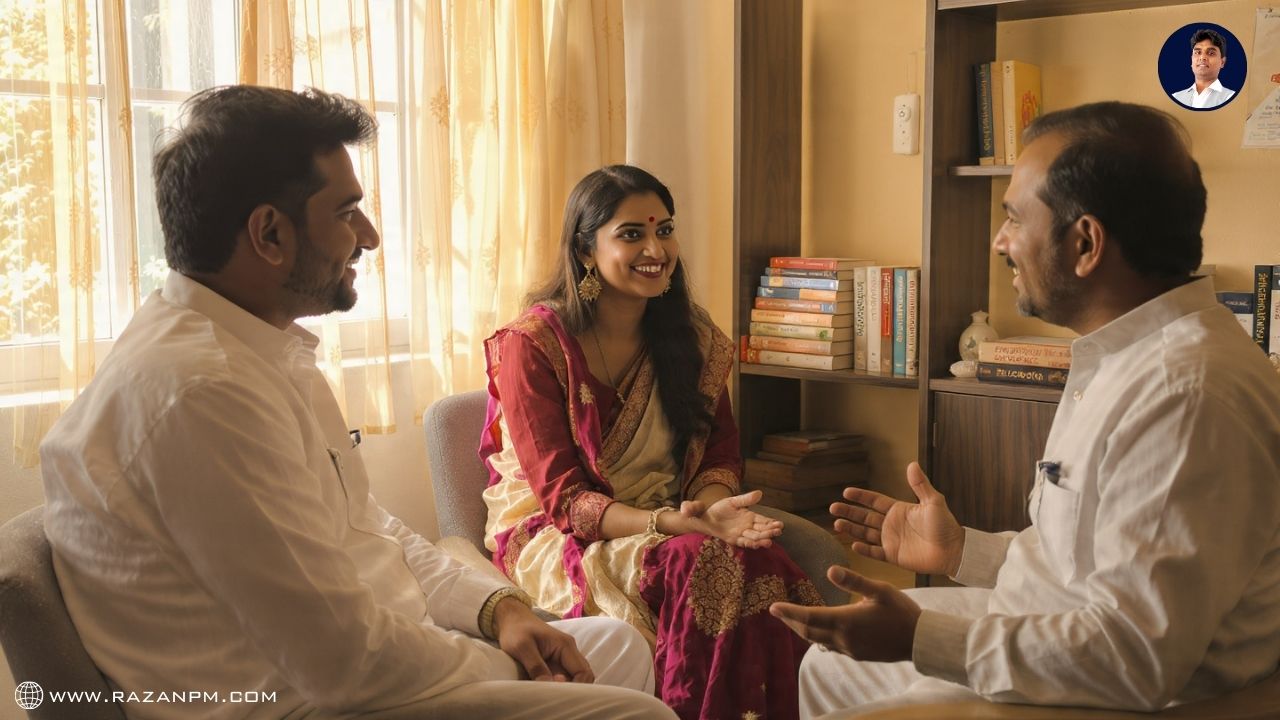
Of course, this is just the starting point.
Resolving deep family dynamics, mother-in-law–wife conflicts, and husband’s emotional triggers requires:
These are deeper layers that go beyond a blog—and are best explored in a safe, guided, therapeutic space.
also read: how disorders like insomnia fueldepression?
If reading this feels personal…
If you have lived this silence…
Or if you love someone who is struggling quietly…
You don’t have to figure it out alone.
I’m here to help you heal the emotional weight, understand the patterns, and rebuild peace in your relationships—step by step, without judgment.
also read: how isolation triggers illness anddepression together?
Book your consultation here – and let’s begin your healing journey together.
👉 Begin Your Journey with a 1 on 1 Consultation
👉 Begin Your Journey with a 1 on 1 Consultation

Q1. Why does my husband become silent during conflicts?
Many husbands go silent because they feel emotionally overloaded. Jab husband ko lagta hai ki woh maa aur wife ke beech phas gaya hai, he enters a freeze mode. Silence becomes a coping mechanism, not disrespect.
also read: how to stop the cycle of pain anddepression?
Q2. Is my husband’s silence a sign of emotional distance?
Not always. Silence often means stress, confusion, and fear of hurting someone. Lekin agar silence frequent ho, long-lasting ho, or emotionally disconnecting lagne lage—then yes, it may indicate emotional distancing.
also read: what to do when i love you gets noreply?
Q3. How can I understand what my silent husband is feeling?
Use gentle words like:
“Whenever you’re ready, I’m here to listen.”
Avoid pushing or interrogating. Men open up when they feel emotionally safe, not pressured.
also read: why timing turns simple talks intobig arguments?
Q4. What should a husband do when stuck between his mother and wife?
Use the line:
“I won’t take sides, but let’s talk calmly.”
This sets boundaries without hurting anyone. Communication—not choosing sides—is the real solution.
also read: how everyday pressure breaks yourmind?
Q5. Can a husband’s silence be linked to psychological stress?
Yes. Silence can be linked to Adjustment Disorder, anxiety, guilt cycles, and triangulation stress, as seen in DSM and ICD frameworks. Emotional overload often shuts down verbal expression.
also read: do voice notes kill realconversations?
Q6. How do I encourage my husband to talk without creating pressure?
Choose a peaceful moment and say softly:
“Your feelings matter. You don’t have to bottle them up.”
Stay patient. Don’t force him to speak immediately.
also read: 12 behaviors that reveal a man issexually frustrate
Q7. Why do small arguments feel bigger in joint families?
Because in joint families, loyalty conflicts are stronger. A small disagreement quickly becomes emotional because expectations from maa and wife are both high.
also read: 9 hidden signs she misses physicalaffection
Q8. What if my husband always sides with his mother?
This is often learned behavior, not intentional bias. Emotional boundaries and communication training help him understand neutrality without guilt.
also read: 8 signs of hidden depression incancer survivors
Q9. Is it normal for a newly married husband to feel confused?
Absolutely. New marriages + new roles + old family expectations = emotional overwhelm. Confusion is natural, but long-term silence needs guidance and support.
also read: how to read body language signs indaily life?
Q10. When should we consider therapy or consultation?
When:
Guided support helps rebuild understanding, boundaries, and emotional clarity.
also read: why digital conversations arekilling real connection?
